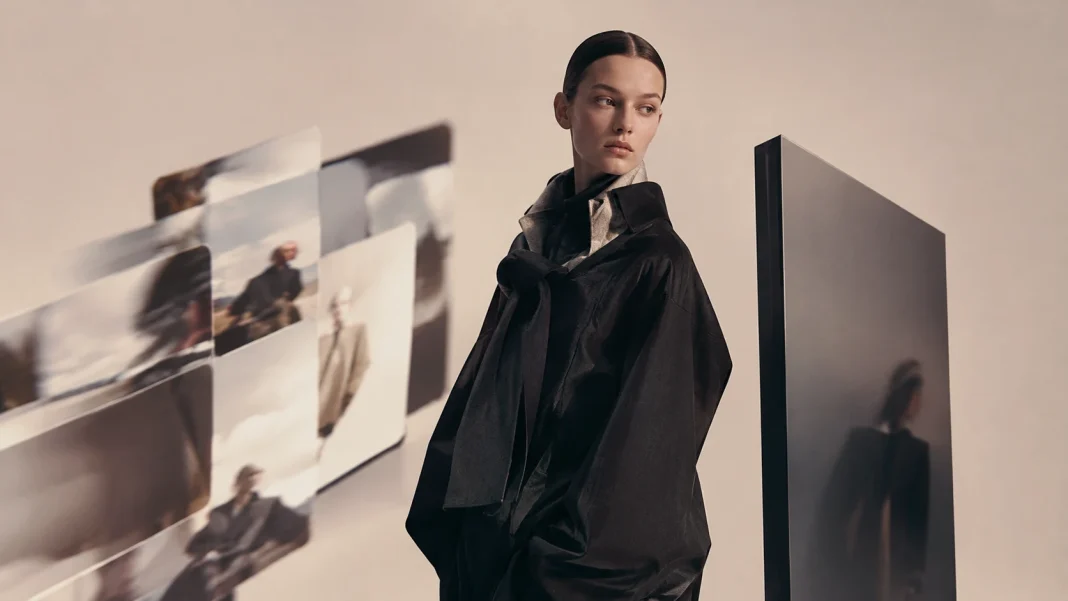
Anti-algorithmic dressing” has entered the fashion vocabulary. Behind the phrase is a longer conversation about personal style, recommendation systems and what happens when millions of people find inspiration through the same feeds.
For years, social media has made fashion easier to find.
Search for loafers, office wear or a winter coat and a platform can quickly produce a stream of outfits informed by previous clicks, searches and interactions. TikTok, Instagram, Pinterest and other visual platforms have shortened the distance between seeing a look, identifying its components and finding something similar to buy.
They have also created a more complicated question for fashion: what happens when personalized discovery begins producing recognizable formulas?
That question has surfaced repeatedly in fashion over the past two years. Now it has a name.
In its latest autumn/winter 2026 trend report, British Vogue identifies “anti-algorithmic dressing” as a developing direction, building on ideas already visible in spring/summer 2026 and connecting the concept with fantasy, storytelling and clothes that move away from conventional style archetypes.
It would be premature to call this a movement. There is no single anti-algorithm wardrobe, nor evidence that consumers are abandoning recommendation platforms en masse.
But the phrase captures a tension that designers, fashion editors and researchers have increasingly been examining: how to preserve individual taste in a culture where taste is also continuously categorized, recommended and reproduced.
Before the name, Prada was already asking the question
An important precursor appeared in Milan in September 2024.
For Prada’s spring/summer 2025 womenswear collection, Miuccia Prada and Raf Simons made algorithms part of the intellectual premise of the show.
The house’s official notes described contemporary life as an era of extreme information, with people receiving a constant stream of online content shaped by algorithms. Against systems based on logic and prediction, Prada positioned humanity as unpredictable.
The language was unusually direct. Individuality, agency, free will, invention and choice were central to the collection’s stated ideas.
The clothes resisted a single, easily summarized character. References to different periods and different versions of Prada appeared beside one another, while individual looks varied sharply across the cast.
Prada did not call this “anti-algorithmic dressing.” Treating the show as the definitive origin of the term would therefore go too far. But it established many of the ideas that would later become associated with the phrase.
The concern was not simply technology. It was predictability.
When recommendation systems learn what someone likes and become increasingly effective at showing more of it, where does surprise come from?
How personal style became a platform question
Fashion has always been shaped by imitation.
Magazines, celebrities, designers, retailers, music scenes and subcultures were influencing what people wore long before recommendation software arrived. People also remain active participants in digital systems: they decide what to follow, search, save, ignore and buy.
Algorithms did not invent fashion conformity.
What digital platforms changed was the scale and speed of the feedback loop.
An aesthetic can now travel through millions of feeds in a remarkably short period. Users reproduce it. Creators see which formats attract engagement. Retailers respond to visible demand. The resulting clothes and images return to the platforms where the process began.
The proliferation of named internet aesthetics made this mechanism particularly visible.
“Cottagecore,” “Barbiecore” and an expanding vocabulary of other “cores” turned complex combinations of references, products and lifestyles into recognizable visual categories. Their usefulness partly came from that legibility: an aesthetic with a name is easier to search, explain and reproduce.
This does not mean algorithms created those tastes. Nor does everyone shown the same content receive it in the same way.
But fashion’s growing interest in anti-algorithmic dressing reflects an uncomfortable contradiction. Systems designed to personalize discovery can also make successful ideas extraordinarily easy to repeat.
Vogue examined that contradiction in 2025 when it asked whether “the algorithm” had become a scapegoat for bland style. Its assessment was more complicated than blaming technology alone. Algorithms can amplify repetition, but brands, creators, commercial incentives and the fashion industry’s preference for ideas that have already demonstrated an audience also contribute to aesthetic convergence.
Anti-algorithmic dressing is therefore better understood as a response to predictability than as a literal rejection of algorithms.
There is no single consumer response
Research into fashion consumption reinforces the need for that distinction.
A 2025 study examining fashion consumers and Instagram recommendations identified contrasting approaches to algorithmic fashion discovery.
Some consumers used recommendations to identify trends, brands and influential figures associated with widely recognized taste. In this context, the algorithm was useful precisely because it helped establish what was current.
Other consumers, particularly those oriented toward independent fashion, behaved differently. For some, increased algorithmic visibility could reduce a style or brand’s value as a source of distinction.
The researchers described one response as “algorithmic preservation,” including behaviors such as avoiding recommendations or manually curating information sources.
The finding does not show that consumers as a whole are turning against algorithms. It shows something more limited but more useful: recommendation systems can serve different functions depending on what someone wants from fashion.
For one person, an efficient recommendation can be valuable guidance. For another, encountering the same reference repeatedly can undermine the sense of discovery that made it attractive in the first place.
That distinction goes to the heart of personal style.
Fashion can communicate belonging, but it can also communicate difference. Digital platforms are unusually effective at facilitating both.
The wider psychological question
Research on algorithmically mediated visual culture also suggests that repeated recommendation and feedback can influence how aesthetic norms are encountered.
A 2025 Frontiers in Psychology study of young women in China examined the relationship between social media use, algorithmic recommendations, self-presentation and aesthetic self-objectification. Its scope was specific and its findings should not be generalized to fashion consumers everywhere.
Nor was the study about anti-algorithmic dressing.
What it does provide is evidence for the wider context in which the fashion discussion is taking place: aesthetic preferences online are not formed in isolation. They operate within systems of repeated exposure, social comparison, interaction and feedback.
That makes the current fashion conversation less about whether algorithms are inherently good or bad than about how much authority people give them over discovery.
The platforms themselves are also part of this discussion. In a 2026 Vogue interview about fashion’s changing relationship with Instagram, Meta’s Eva Chen emphasized the continued importance of human point of view and taste even as recommendation systems become more sophisticated.
Technology can become better at finding relevant material. Deciding what is interesting is a different problem.
By 2026, the idea had evolved
The runway response has also changed.
Prada returned to questions of agency for autumn/winter 2026, but this time the proposition was unusually practical.
The house built the show around layering and transformation. Fifteen models appeared four times, with their looks changing as garments were removed and combinations altered.
Backstage, Raf Simons framed the exercise through questions about what could be worn with what, what was possible and whether it could be done another way.
That moves the conversation beyond simply designing unusual clothes.
Individuality can come from recombination.
The distinction matters because a fashion industry responding to homogenization could easily create another contradiction: selling consumers increasingly eccentric products in the name of being different.
Prada’s AW26 proposition suggested another possibility. The same wardrobe can produce different outcomes depending on how someone uses it.
In that sense, styling itself becomes an expression of agency.
Fantasy offers another route out of the formula
Louis Vuitton took a very different approach for autumn/winter 2026.
Nicolas Ghesquière presented the collection in the summer apartments of Anne of Austria at the Louvre, transformed into a moss-covered environment with Severance production designer Jeremy Hindle.
The collection drew on pastoral and folkloric references, including sculptural cloaks inspired by the Turkish kepenek and sheep motifs created by Ukrainian artist Nazar Strelyaev-Nazarko. Louis Vuitton described the collection through ideas of contemporary pastoralism and futuristic folklore.
British Vogue placed Louis Vuitton within its discussion of anti-algorithmic dressing, alongside a broader turn toward fantasy and storytelling.
That distinction is important.
Louis Vuitton did not need to declare a garment “anti-algorithmic” for critics to see the collection as part of the wider conversation. The relevance lies instead in its use of narrative, unexpected references and combinations that resist being reduced to one familiar online archetype.
Prada and Louis Vuitton therefore arrive at similar territory from very different directions.
One emphasizes recombination and choice. The other leans into imagination and narrative.
Neither provides a uniform for dressing against an algorithm.
That may be precisely the point.
The contradiction at the center of anti-algorithm fashion
There is an obvious problem with the term itself.
Once “anti-algorithmic dressing” acquires a name, appears in trend reports and circulates through TikTok, Instagram and Pinterest, it becomes searchable.
Once it becomes searchable, it can become reproducible.
Fashion has seen this cycle repeatedly. A style emerges from a designer, community or cultural context. Platforms increase its visibility. A recognizable label develops around it. Creators reproduce the format, consumers search for it and retailers respond.
What originally looked like an expression of individuality can eventually become another template.
This makes anti-algorithmic dressing fundamentally different from a conventional trend such as a particular color, skirt length or boot.
If it develops a fixed visual uniform, the idea begins to contradict itself.
A deliberately mismatched outfit can become a formula. Vintage layering can become a formula. Even dressing that looks spontaneous can become highly recognizable once enough people reproduce the same version of spontaneity.
The algorithm does not necessarily defeat resistance to conformity. It can simply learn what that resistance looks like.
Fashion cannot really leave the algorithm
There is another reason to avoid treating this as a rebellion.
The contemporary fashion industry operates deeply inside the digital economy.
Luxury houses use social media to distribute runway imagery and campaigns. Designers work with creators and celebrities whose reach depends partly on platforms. Consumers discover independent labels through recommendation systems. Retailers use data to understand demand.
Algorithms can also broaden fashion discovery. Someone far from Paris, Milan or London can encounter an emerging designer, historical archive or niche subculture that would once have been considerably harder to find.
There is no simple line separating algorithmic fashion from authentic personal style.
Nor are designers somehow outside the system simply because a collection celebrates individuality.
What has changed is that fashion appears increasingly willing to acknowledge the tension.
Prada’s language of unpredictability in 2024, the continuing emphasis on agency and styling in 2026, and British Vogue’s adoption of “anti-algorithmic dressing” as a trend category all belong to that developing conversation.
It is a conversation about who chooses.
Personal style after personalization
That may ultimately be why the phrase matters.
For most people, dressing against an algorithm will not mean deleting social media or deliberately wearing strange clothes. It may not look visibly rebellious at all.
The more interesting idea is that inspiration and instruction are not the same thing.
Recommendation systems are exceptionally good at supplying the former. They can identify patterns in taste, surface relevant images and make fashion discovery faster than at any previous point in media history.
But personal style has always depended on selection: what someone keeps, rejects, combines, repeats and changes.
“Anti-algorithmic dressing” may eventually disappear as a term. Fashion vocabulary moves quickly, and the phrase itself is vulnerable to exactly the cycle of repetition it describes.
The question behind it is likely to last longer.
As platforms become better at predicting what people want to see, fashion is being forced to reconsider something it once took for granted: whether personal style is defined by finding the right things, or by deciding what to do with them once everyone else can find them too.